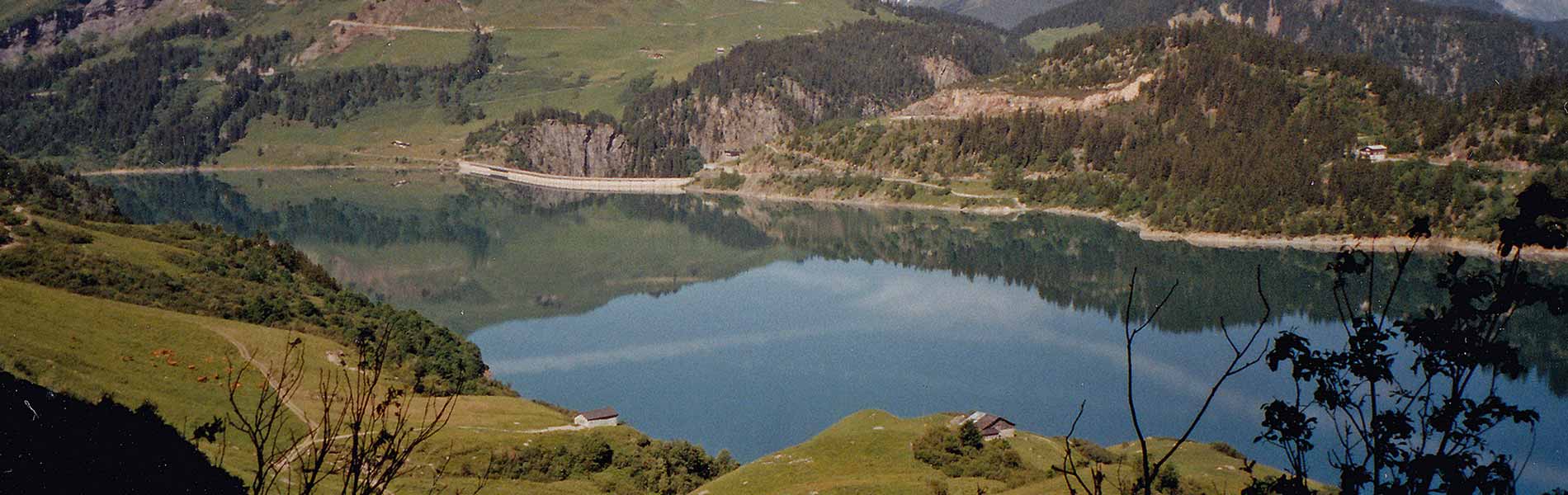
Cormet de Roselend: the 1,968 m pass in the Beaufortain
In short
The Cormet de Roselend, 36 minutes from the campsite, peaks at 1,968 metres between the Beaufortain and Mont Blanc massifs. You can admire the turquoise Lake Roselend and its dam, with a 20-kilometre hike all the way around it.
Key takeaways
- Altitude: 1,968 m
- Massif: Beaufortain, Savoie
- North climb: 20.3 km from Beaufort, 6% average gradient
- South climb: 19.3 km from Bourg-Saint-Maurice
- Open: late May to mid-October (depending on snow)
- Must-see: the Roselend dam and its submerged chapel
The Cormet de Roselend peaks at 1,968 m in the Beaufortain massif, in Savoie, and is one of the most memorable passes on the Route des Grandes Alpes. From our campsite in the heart of Savoie, in Landry, you reach the top in less than 40 minutes by road. On the menu: hairpin bends, a chapel submerged under Lake Roselend, and views of Mont Blanc and the Beaufortain peaks.
The Camping L’Eden de la Vanoise team shares the route, the history of the site and the best activities to plan there.
A legendary Beaufortain pass
The Cormet de Roselend links the Beaufortain valley to the Tarentaise, between Beaufort and Bourg-Saint-Maurice. The road climbs in regular hairpins through pastures, mountain barns and spruce forests, with constant views of the neighbouring peaks. On the north side, the climb stretches over 20.3 km at an average of 6%, peaking at 9.5%. On the south side, 19.3 km of technical descent await cyclists and bikers.
The pass is classed beyond category in the Tour de France and regularly features in the race. In 1996, it made sporting history: Belgian rider Johan Bruyneel missed a bend on the descent and disappeared into a ravine before climbing back out miraculously unhurt. Since then, the pass has held a special place for cycling fans.
Lake Roselend and its dam, a unique site
Lake Roselend lies at 1,553 m, just before the final climb to the pass. The Roselend dam, filled between 1955 and 1962, holds back 187 million m³ to supply the La Bâthie hydroelectric plant. Its construction submerged the old hamlet of Roselend and its chapel; a new chapel, a faithful replica of the old one, was rebuilt higher up in 1961.
This highlight of the Route des Grandes Alpes attracts bikers, cyclists and hikers every summer with its turquoise waters and pasture setting. The Roselend dam is also one of the most beautiful lakes in Savoie, alongside Lake Annecy and Lac du Bourget.
Our favourite : in calm weather, the lake becomes a perfect mirror of the peaks. We recommend going early in the morning to catch this rare light, before the cars arrive and the midday thermal wind picks up.
What to do at the Cormet de Roselend?
The site lends itself to several types of visit depending on your profile: Sunday walker, experienced athlete or mountain driving enthusiast. Our team shares the best activities here.
Hikes around Lake Roselend
Several trails start from the lakeshore and from the top of the pass. The lake loop (10 km, 3 hours of walking) is the most accessible for families. Experienced hikers will prefer the Pierra Menta loop, one of the iconic peaks of the Beaufortain. Find our full selection in our article on 5 hiking routes in the Beaufortain, with ascents, durations and levels.
Cycling, motorbiking and a panoramic road
The Cormet de Roselend is one of the benchmark cycling climbs, often mentioned alongside the Galibier and the Iseran. Bikers enjoy its regular hairpins and long, open views. For a stress-free ride, choose the 9-11 am slot: the light is beautiful, traffic still moderate and temperatures pleasant. Bring a windproof layer for the top, even in July and August.
Our team's tip : after several seasons advising our guests, we recommend climbing from the Beaufort side and descending towards Bourg-Saint-Maurice. The north climb keeps the morning cool, and the more technical south descent is easier with warm brakes and rested eyes.
Planning to cross the Cormet de Roselend? Book your stay at Camping L’Eden de la Vanoise and enjoy an ideal starting point, less than 40 minutes from the pass and 15 minutes from Bourg-Saint-Maurice.
 Sébastien’s tip
This pass is great for a bike ride if you are fit, but bring a windproof jacket even in summer: the wind blows hard near the top. If you go hiking, check the weather the day before, storms build up quickly at altitude on this kind of exposed route.
See on the map
Frequently asked questions
What is the altitude of the Cormet de Roselend?
The Cormet de Roselend peaks at 1,968 m, in the Beaufortain massif in Savoie. It is one of the highest passes in the department, just behind the Col de la Madeleine (2,000 m) and well behind the Iseran (2,764 m). Its central position between Beaufort and Bourg-Saint-Maurice makes it a strategic crossing in the Alps.
When does the pass open and close?
The Cormet de Roselend usually opens between late May and early June, depending on snow cover. It closes with the first autumn snowfall, between mid-October and early November. Check the official Savoie road conditions map before you leave, as the pass can close temporarily in bad weather, even in high season.
Can you see the submerged chapel in the lake?
The submerged chapel of the Roselend dam is only visible when the lake is drained for its ten-yearly maintenance, a rare operation. Normally, its remains lie under several tens of metres of water. A faithful replica was rebuilt higher up in 1961, next to the old village: it can be visited freely and recalls the history of the site.
How do you get to the Cormet de Roselend by car?
From Bourg-Saint-Maurice, allow about 30 minutes via the D902. From Albertville, allow 1 hour via the D925 then the D218b through Beaufort. From our Camping L’Eden de la Vanoise in Landry, you reach the top in less than 40 minutes. There is a free car park at the pass and another by the lake.