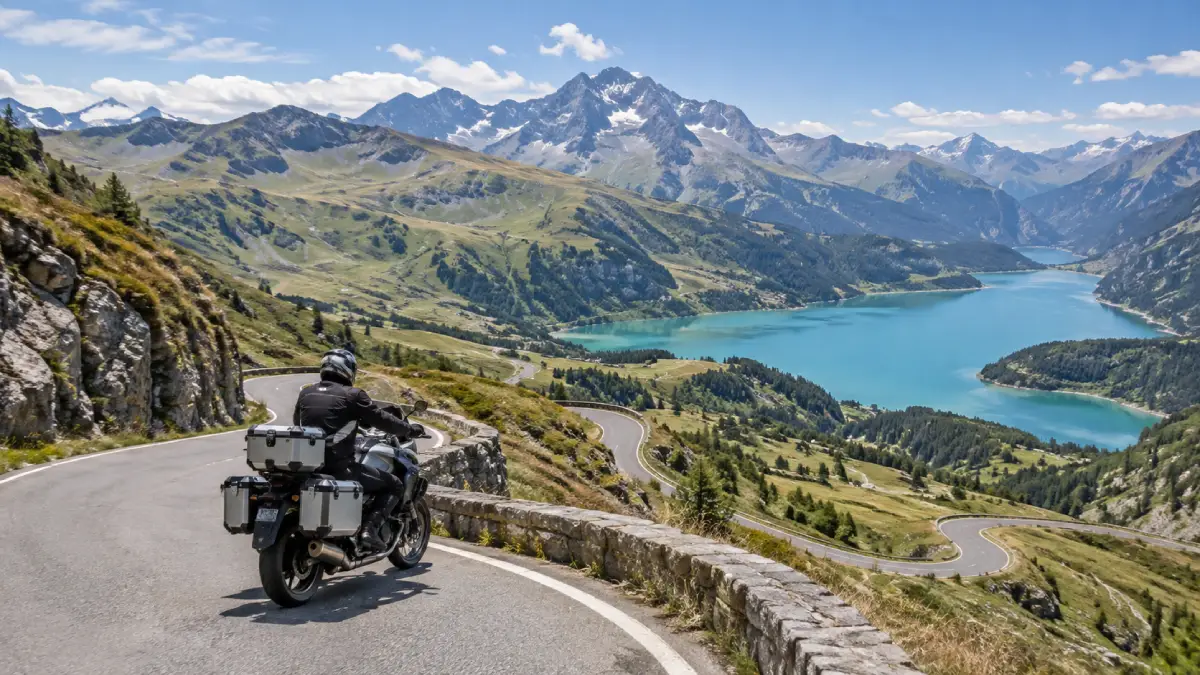
Route des Grandes Alpes by motorbike: the 3 Savoie passes
Key takeaways
- Total distance: around 720 km between Thonon-les-Bains and Menton, across 17 Alpine passes.
- Savoie: 3 major passes on the official route (Cormet de Roselend, Iseran, Little St Bernard).
- Best time: from mid-June to mid-September, when all the passes are open.
- Recommended duration: 5 to 7 days to ride the whole route.
- Ideal base: our 3-star campsite in Landry, between Bourg-Saint-Maurice and Aime.
The Route des Grandes Alpes by motorbike covers nearly 720 km of tarmac between Thonon-les-Bains and Menton, punctuated by 17 legendary passes. Three of them cross Savoie and provide the finest stages of the route: the Cormet de Roselend, the Col de l’Iseran, the highest paved pass in the Alps, and the Little St Bernard Pass between France and Italy.
The team at our Eden de la Vanoise campsite, a biker-friendly campsite in Landry, shares the itinerary, the best stops and practical tips for a stress-free ride.
A legendary route from the north to the south of the Alps
The Route des Grandes Alpes links Lake Geneva to the Mediterranean, crossing the Chablais, Beaufortain, Vanoise, Queyras and Mercantour massifs. It takes in 17 Alpine passes and climbs as high as 2,764 m at the Col de l’Iseran. From Thonon-les-Bains, the route heads down to Cluses, Beaufort, Bourg-Saint-Maurice, Val-d’Isère, Bonneval-sur-Arc and then Briançon before reaching Menton.
In Savoie, the central section concentrates three major passes that make the Route des Grandes Alpes by motorbike unforgettable. Each section has its own signature: hairpin bends in the Beaufortain, long climbs in Haute-Maurienne, a border crossing into the Aosta Valley. Camping L’Eden de la Vanoise, in Landry, is less than 40 minutes from the start of all three passes, an ideal base to ride them over several days.
Our team’s tip: set off early in the morning to ride before the tourist rush and enjoy the views in softer light.
The 3 Savoie passes not to be missed
On the official route, three Savoie passes form the Alpine heart of the itinerary. Each one deserves a stop for a photo, a coffee or a short walk at the top.
The Cormet de Roselend, 1,968 m
The Cormet de Roselend pass climbs to 1,968 m in the Beaufortain massif. From Beaufort, the ascent stretches over 20.3 km at an average gradient of 6%. The pass overlooks Lake Roselend, whose turquoise waters closed over an old chapel in 1960. The descent towards Bourg-Saint-Maurice strings together hairpins over 19.3 km: a treat for bikers. The pass is usually open from late May to mid-October, depending on snowfall.
The Col de l’Iseran, 2,764 m
The Col de l’Iseran is the highest paved pass in the Alps, at 2,764 m. The road links Bourg-Saint-Maurice to Bonneval-sur-Arc via Val-d’Isère. It crosses the Vanoise National Park, with mineral landscapes, glaciers visible in the distance and a true high-mountain atmosphere. The Iseran rarely opens before early June and closes again with the first autumn snow. Bring thermal layers: the temperature drops quickly above 2,500 m.
The Little St Bernard Pass, 2,188 m
The Little St Bernard Pass peaks at 2,188 m and marks the border between France and the Aosta Valley. From Bourg-Saint-Maurice, the climb winds through 30 km of gentle bends, with views of the Mont Blanc massif. At the top, an old hospice and a Celtic stone circle recall the thousand-year history of the crossing. The Italian descent runs down to La Thuile, then Aosta: a perfect round trip for a change-of-scene day on the bike.
Practical tips for a stress-free ride
Riding the Route des Grandes Alpes by motorbike successfully takes a little preparation. Conditions change quickly at altitude and the Savoie passes are not to be improvised.
Use a simple checklist before each stage:
- Always check the evening before that the passes are open, on the departmental websites.
- Pack thermal layers: at the top of the Iseran, the temperature can drop below 10°C even in August.
- Fill up in Bourg-Saint-Maurice before tackling the Iseran, there is no fuel station until Val-d’Isère.
- Ride at a moderate pace in damp hairpins, which are common early and late in the day.
- Allow extra time for summer traffic, especially on the Val-d’Isère to Bonneval-sur-Arc section.
Where to stay on the route: our biker campsite in Savoie offers shaded pitches suited to motorbikes, a covered communal area and modern washrooms. A strategic base in Landry, 15 minutes from the start of the three passes.
The official route crosses Savoie via 3 passes, but our department has many other roads to discover on two wheels. See our guide to the most beautiful motorbike passes in Savoie to extend your road trip beyond the classic route: secondary passes, day loops and little-known viewpoints.
Planning your Alpine road trip this summer? Book your stay at Camping L’Eden de la Vanoise and enjoy a strategic base 35 minutes from the Cormet de Roselend and 45 minutes from the Col de l’Iseran via Bourg-Saint-Maurice.
Sources
- Official Route des Grandes Alpes: https://www.routedesgrandesalpes.com/grands-cols/cormet-de-roselend
- Live pass openings: https://cols-en-direct.fr/beaufortain/cormet-de-roselend/
- Auvergne-Rhône-Alpes Tourisme: https://legrandtour.auvergnerhonealpes-tourisme.com/incontournables/le-col-de-liseran/
- Haute-Maurienne Vanoise Tourisme: https://www.haute-maurienne-vanoise.com/en/legendes-col-de-liseran/
Frequently asked questions
How many days do you need for the Route des Grandes Alpes by motorbike?
Ideally, allow 5 to 7 days for the Route des Grandes Alpes by motorbike, to enjoy the passes, the stops and the views without racing against the clock. Some seasoned riders complete it in 3 days, but the route loses its appeal. A week remains the right balance between discovery and riding pleasure.
What is the best time of year to ride?
From mid-June to mid-September, all the passes on the Route des Grandes Alpes are open. The Iseran is the last to open (often early June) and the first to close (usually late October). July and August are the busiest months: June and early September offer quieter conditions and clearer roads.
Is the Route des Grandes Alpes difficult by motorbike?
Yes, the Route des Grandes Alpes calls for experience. It strings together 17 high-mountain passes, often above 2,000 m, with tight bends and steady gradients. An experienced rider will cope well, provided they ride in short stages, stay hydrated and keep their distance on technical descents.
Can you ride it on a roadster or a large adventure bike?
Absolutely. The Route des Grandes Alpes suits all types of road and adventure motorbikes. Road surfaces are generally good, apart from a few damaged sections early in the season. Large adventure bikes remain the best compromise for comfort on long passes and stability in tight hairpins. Fit good dual-purpose tyres.