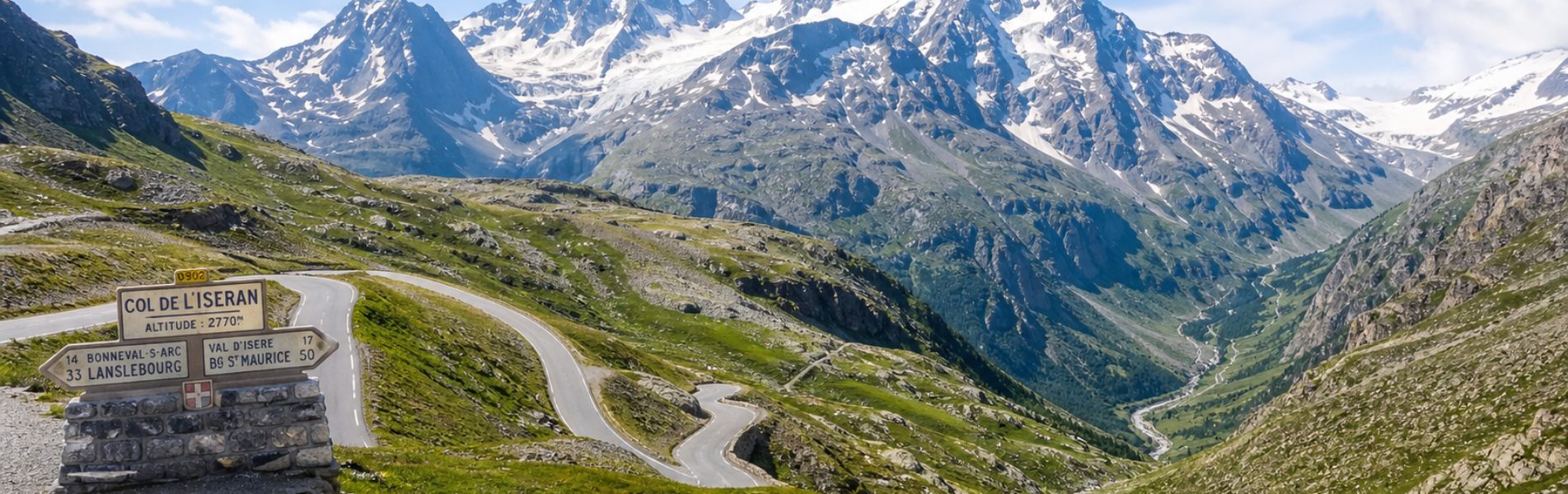
Col de l’Iseran: climbing to 2,764 m
In short
The Col de l’Iseran peaks at 2,764 m between Val d’Isère and Bonneval-sur-Arc, making it the highest paved pass in the Alps. The road is only open from June to October, and the bike climb from Val d’Isère covers 17 km with 970 m of ascent. At the top stands the Notre-Dame de Toute Prudence chapel, the highest in France.
Key takeaways
- The Col de l’Iseran peaks at 2,764 m, making it the highest paved pass in the Alps.
- The road links Val d’Isère, in the Tarentaise, to Bonneval-sur-Arc, in the Maurienne.
- The pass is open from around early June to late October, then closes for the winter.
- The bike climb covers 17 km and 970 m of ascent from Val d’Isère.
- At the top stands the Notre-Dame de Toute Prudence chapel, the highest in France.
The Col de l’Iseran links Val d’Isère to Bonneval-sur-Arc and peaks at 2,764 m, making it the highest paved pass in the Alps. Its road only opens in summer, for a few snow-free months. Cyclists, bikers and lovers of panoramic views come to cross this legendary pass on the Route des Grandes Alpes. This iconic pass is easy to reach from our campsite in Savoie, in the Tarentaise.
From our campsite in Haute-Tarentaise, you reach the foot of this road summit in less than 60 km, via Val d’Isère. Here is everything you need to know before you go up!
The Col de l’Iseran, the highest paved pass in the Alps at 2,764 m
At 2,764 m, the Col de l’Iseran stands as the highest paved pass in the Alps. The sign at the top nevertheless says 2,770 m, a difference inherited from old measurements. Above all, the pass acts as a link between two major Savoie valleys: the Tarentaise to the north, via Val d’Isère, and the Maurienne to the south, via Bonneval-sur-Arc. As it crosses from one side to the other, the road passes over the watershed between the Isère and the Arc. It is also one of the most beautiful sections of the Route des Grandes Alpes, the 722 km route that runs from Lake Geneva down to the Mediterranean, also passing the Col de la Madeleine, further south. All around, the peaks of the Vanoise National Park create a mineral, high-mountain setting.
When to go up the Col de l’Iseran?
The Col de l’Iseran road usually opens from early June to late October, once the snow has been cleared. Snow clearing determines the exact reopening date each year. For the rest of the year, the pass is closed to traffic, and snowfields still line the road until early summer.
Once the road is open, high-mountain weather remains unpredictable: a sunny morning can turn stormy at altitude by the afternoon. It is therefore best to aim for mid-morning to cross the summit in the dry.
Getting to the start could not be easier from our Eden de la Vanoise campsite: you head up the Isère valley, then through Val d’Isère, to the foot of the climb!
Climbing the Col de l’Iseran by bike from Val d’Isère
From Val d’Isère, the climb up the Col de l’Iseran by bike covers 17 km with 970 m of ascent, an average gradient of nearly 6%. This average hides big variations, as the profile is smooth at first before steepening sharply in the last third. In practice, the climb breaks down into several distinct sections:
- The first 5 kilometres, up to the Pont Saint-Charles, climb gently along the Isère.
- The middle section alternates flat stretches and short steep ramps, in a landscape that becomes increasingly bare.
- The last 2 kilometres approach 9%, just before the summit sign.
Our tips: take a windproof jacket, even in fine weather. At the top, the air rarely exceeds 10 degrees and the wind blows hard on the final flat section. A full water bottle and rested legs do the rest. The gradient has to be earned, but the view of the glaciers rewards every pedal stroke.
What to see at the top of the Col de l’Iseran?
The summit of the Col de l’Iseran offers much more than a simple altitude sign. Once at the top, two curiosities catch the attention of travellers who stop there.
The highest chapel in France
By the roadside stands the Notre-Dame de Toute Prudence chapel, the highest chapel in France. Built in 1938 and inaugurated in 1939, it is the work of the architect Maurice Novarina. For almost a century, its stone silhouette has watched over travellers crossing the pass.
A legendary Tour de France pass
The Col de l’Iseran has been crossed eight times by the Tour de France, each time as the highest point of the race. The most memorable was the 2019 edition: that day, the stage to Tignes was neutralised at the summit after a violent hailstorm, which propelled Egan Bernal into the yellow jersey. Since then, the pass has remained etched in the memory of cycling fans.
Fancy taking on the Col de l’Iseran from an ideal base in Haute-Tarentaise? Book your stay at Camping l’Eden de la Vanoise, in Landry, and head out each morning to the most beautiful passes in Savoie. Your mountain holiday starts here!
 Sébastien’s tip
Go up early, as soon as the road opens if you can: the summit is empty at sunrise and the low light skims the glaciers, the best time for photos. After 10 am, groups of bikers and cyclists arrive in numbers and the wind picks up on the final flat section.
See on the map
Frequently asked questions
Is the Col de l’Iseran open all year round?
No, the Col de l’Iseran is not open all year round. The road is open from around early June to late October, then closes with the first snow. In winter, the pass between Val d’Isère and Bonneval-sur-Arc is closed to vehicles.
What is the exact altitude of the Col de l’Iseran?
The Col de l’Iseran peaks at 2,764 m, even though the sign at the top says 2,770 m. This altitude makes it the highest paved pass in the Alps, ahead of many Savoie giants.
How long does it take to climb the pass by bike?
The time depends on your fitness. From Val d’Isère, allow 17 km of climbing with 970 m of ascent: a trained cyclist reaches the top in an hour and a half to two hours, longer at a gentle pace.
Can you drive over the Col de l’Iseran?
Yes, you can cross the Col de l’Iseran by car or motorbike during the summer season. The road links Val d’Isère to Bonneval-sur-Arc, along the Route des Grandes Alpes. Take care on the bends and drive smoothly at altitude.